-
 WhatsApp: +86 19941574798
-
 sale06@kfqizhongji.com
 WhatsApp: +86 19941574798
sale06@kfqizhongji.com
WhatsApp: +86 19941574798
sale06@kfqizhongji.com
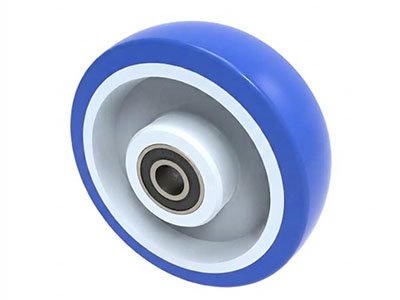
High-performance cast polyurethane wheels solve the chronic issues of de-bonding and flat-spotting that plague standard injection-molded airport systems.
In the high-intensity environment of an airport terminal, the Baggage Reclaim is a relentless workhorse. Operating 24/7. these systems rely on hundreds of specialized wheels to keep passenger luggage moving. However, when these wheels reach their service limit, maintenance teams face a critical choice: Should you replace like-for-like with standard parts, or is it time for an "aviation-grade" technical upgrade?
If your current wheels—typically mass-produced injection-molded versions—are showing signs of premature wear, de-bonding, or flat-spotting, switching to Cast Polyurethane (PU) wheels is the strategic move to restore terminal efficiency.
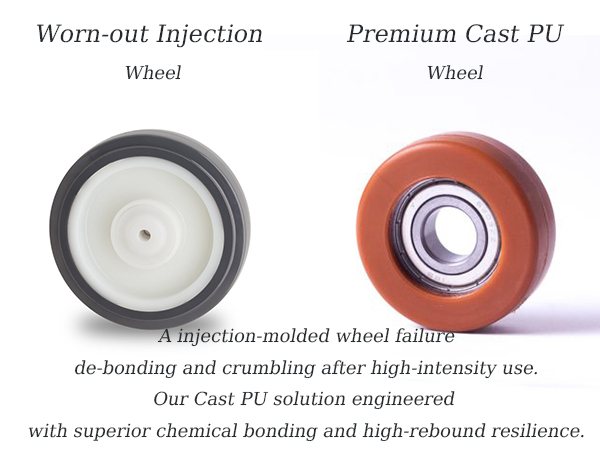
Signs of Worn-Out Injection Wheels
After thousands of operational hours, standard injection-molded wheels often exhibit specific failure modes that signal the need for an immediate upgrade:
1. De-bonding: The tread begins to peel away from the hub, a common failure in injection molding where the physical grip fails under stress.
2. Permanent Flat-Spots: The wheels deform under the heavy weight of stationary luggage, leading to violent vibrations upon restart.
3. Excessive Squealing: High-pitched noise indicating that the material has hardened and lost its essential friction coefficient.
The Casting Advantage: Engineering for Endurance
While injection molding is suitable for low-cost, light-duty applications, the Casting (Bonded) process is engineered for the rigors of heavy-duty airport logistics. Here is why cast PU is the superior choice for your next overhaul:
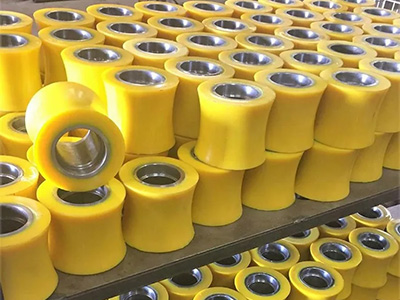
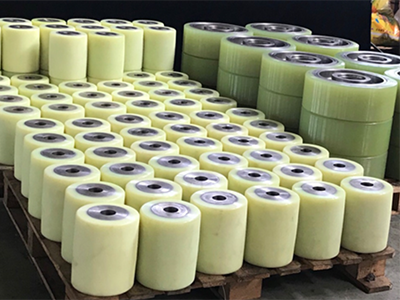
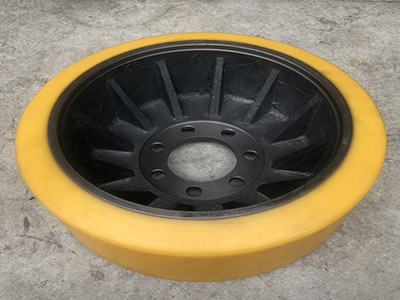
1. Molecular-Level Chemical Bonding: Unlike injection molding, which relies on a mechanical "shrink-fit" to the hub, cast polyurethane is chemically bonded. During the curing process, the PU elastomer creates a molecular link with the metal core. This virtually eliminates the risk of de-bonding, even under the intense lateral forces found in guide wheels.
2. Superior Load-Bearing & Recovery: Cast PU is a thermoset material with a dense, cross-linked molecular structure. This provides much higher resilience than the thermoplastic (TPU) used in injection molding. For load wheels, cast PU resists flat-spotting, ensuring a smooth, vibration-free operation even after sitting idle under hundred-ton loads.
3. Maximum Wear Resistance: The casting process allows for high-performance formulations (such as NDI or PPDI systems) that are far more durable than standard resins. In identical conditions, a cast PU wheel typically offers 2 to 3 times the service life of an injection-molded counterpart.
The ROI Logic: Why "Premium" Means "Savings"
While the initial cost of a cast polyurethane wheel is higher, the long-term Return on Investment (ROI) is undeniable for hub airports:
1. Reduced Labor Costs: Doubling the wheel's lifespan means halving the man-hours spent on replacement cycles.
2. Eliminating Downtime: In a busy terminal, the cost of an unscheduled shutdown far exceeds the price difference of the wheels.
3. System Protection: Higher-quality drive wheels provide better traction, reducing strain on the carousel’s electric motors and gearbox.
Conclusion
An efficient baggage system is only as reliable as its smallest component. When your carousel wheels show signs of wear, don’t just fix the problem—solve it permanently.
By transitioning from standard injection-molded parts to high-performance cast polyurethane wheels, you are investing in "aviation-grade" reliability. Ensure your luggage keeps moving silently and steadily, crossing the finish line of every journey in pristine condition.
16 Sets of Semiconductor Automated Guided Vehicles (AGVs) Wheels Shipped to Japan
Choosing Flame Retardant PU Wheels: Why Reactive Outperforms Additive